
Contents
About the author

Edward A. St. Germain created AmericanRevolution.org in 1996. He was an avid historian with a keen interest in the Revolutionary War and American culture and society in the 18th century. On this website, he created and collated a huge collection of articles, images, and other media pertaining to the American Revolution. Edward was also a Vietnam veteran, and his investigative skills led to a career as a private detective in later life.
Contents
Quick facts
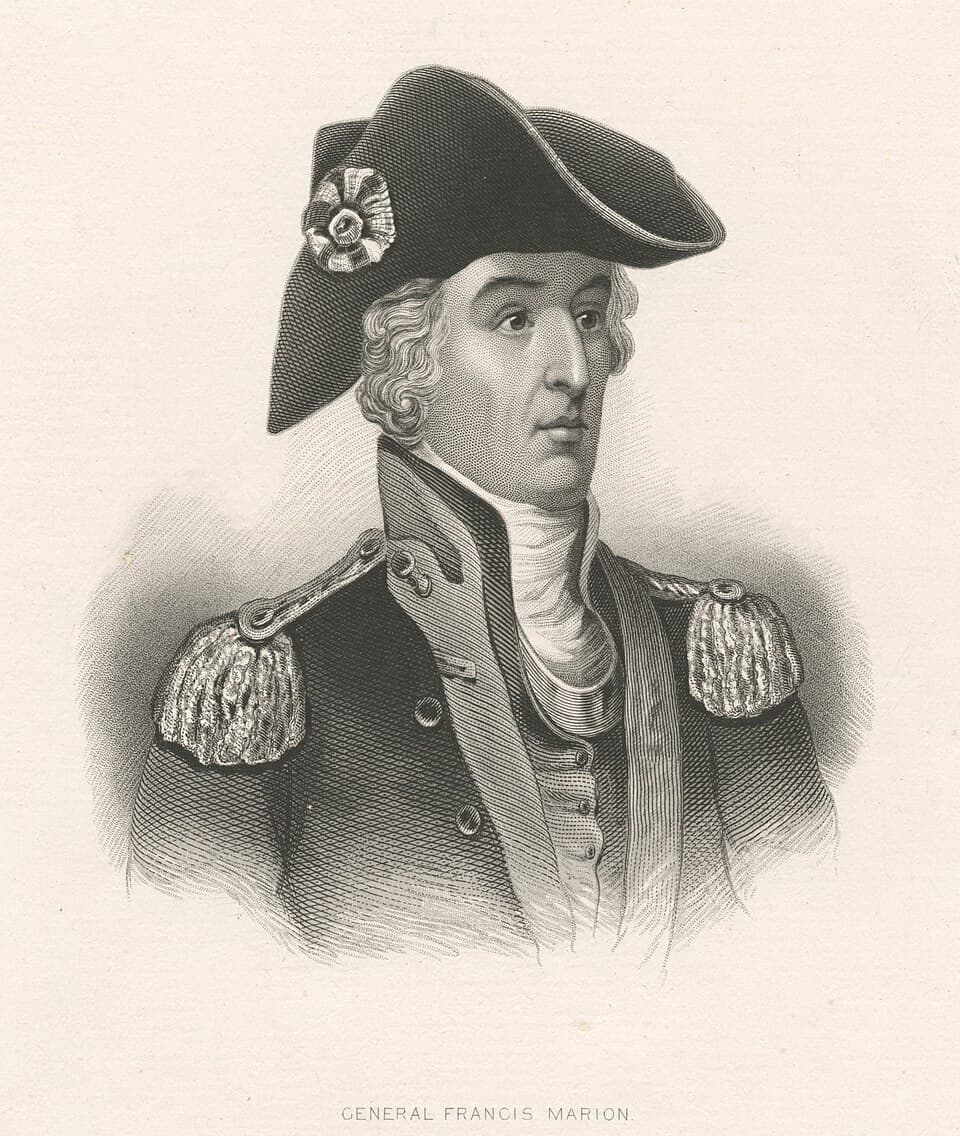
- Francis Marion was born in 1732 on the family plantation in Berkeley County, South Carolina.
- He joined the military in 1756, later fighting in the French and Indian War in the Carolinas.
- As the Revolutionary War broke out, Marion joined the Patriot forces, enlisting in the Continental Army, and eventually rising to the rank of Brigadier General.
- Beginning in 1780, Marion established his own fighting force, known as Marion’s Men, which terrorized the British Army and Loyalist forces in South Carolina using guerrilla-style raids. Operating out of swampy terrain, Marion’s effectiveness in harassing and raiding British forces and logistics systems eventually earned him the nickname “Swamp Fox”.
- After the war, Marion served in the South Carolina State Senate.
- He died on February 27, 1795, aged 63, at his Pond Bluff plantation, in modern-day Orangeburg County, South Carolina.
Early life
Francis Marion was born to a Huguenot family that migrated to the colonies from France in the 1690s, beginning with Francis’s grandparents, Benjamin and Judith Marion.
Francis was the youngest of six children born to Gabriel (Benjamin and Judith’s son) and Esther Marion at their Goatfield Plantation in Berkeley County, South Carolina.
Little information survives about Marion’s childhood and upbringing. However, it is thought that one of his first jobs as a teenager was on a merchant ship, which sank on its way to the Caribbean during Marion’s first trip on board. He was eventually rescued after spending a week at sea in the ship’s lifeboat.
Having decided that life at sea wasn’t for him, Marion returned to work in agriculture on the family plantation. Later, in his early twenties, Marion joined the local militia.
Early military career
Marion’s first military experience was during the Anglo-Cherokee War, which took place in the Southern Colonies as part of the larger French and Indian War.
Marion fought for the colonial forces against the Cherokee nation beginning in 1759, rising to the rank of first lieutenant, including taking part in raids into native-held territory.
He served under Captain William Moultrie, who later described Marion as a brave soldier and an excellent officer.
These expeditions were extremely destructive. As the colonists began to gain the upper hand in the conflict, Cherokee settlements and crops were burned in an effort to make them negotiate for peace. Marion is said to have abhorred the destruction of native communities and civilian settlements.
After the Cherokee War, Marion returned to civilian life in agriculture. In 1773, he established Pond Bluff Plantation, roughly four miles south of Eutaw Springs on the Santee River, and also participated in local government in South Carolina.
Throughout his career as a planter, Marion used slave labor – it was estimated he had 73 slaves by the time of his death.
The Revolutionary War begins
As tensions grew between colonial and British forces in 1775, Marion sided with the Patriot movement, and soon joined the colonial militia forces.
He rose through the ranks quickly, becoming captain in the 2nd South Carolina Regiment in June 1775, once again under the command of Colonel William Moultrie. Marion participated in the Patriot seizure of Fort Johnson in Charleston Harbor that September, and soon rose to the rank of major.
Marion’s first involvement in the Revolution came at the Battle of Sullivan’s Island on June 28, 1776.
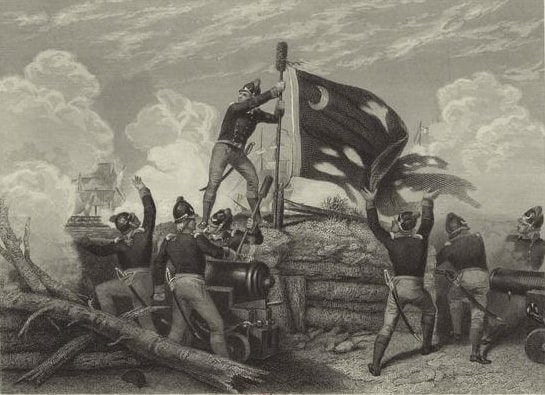
Moultrie’s troops defended an unfinished fort against a powerful Royal Navy attack, which was intended to capture the city of Charleston. However, the defenders held their ground against all odds, forcing the British to withdraw, and marking one of the first major American victories of the Revolutionary War.
Marion distinguished himself during the battle and subsequently became a lieutenant colonel in the Continental Army.
He continued serving, commanding the 2nd South Carolina Regiment in a failed expedition in 1779 to recapture Savannah, Georgia, from the British Army.
The fall of South Carolina
Marion was based in Charleston when the city was besieged by the British in 1780, but had injured his foot – by some accounts breaking his ankle escaping a drinking party through an open window – just prior to the battle commencing.
He moved to the countryside to recover from his injury, miraculously allowing him to escape British capture when Patriot-held Charleston eventually surrendered on May 12, 1780.
From this point on, South Carolina quickly fell into British control.
In August 1780, an American force commanded by Major General Horatio Gates was crushed by Lord Cornwallis at the Battle of Camden. At the time, Marion had been fighting alongside Gates, but when the battle took place, he had been sent to disrupt British communications and river crossings away from the main battlegrounds, allowing him to once again avoid capture.
Swamp Fox
It was at this time that Marion adopted guerrilla tactics to disrupt British control of South Carolina.
He organized a small, tight-knit volunteer militia of approximately 50-100 men, which would grow larger for certain operations. Though they had military experience, many had day jobs such as working as farmers, and would occasionally take leave to attend to their work.
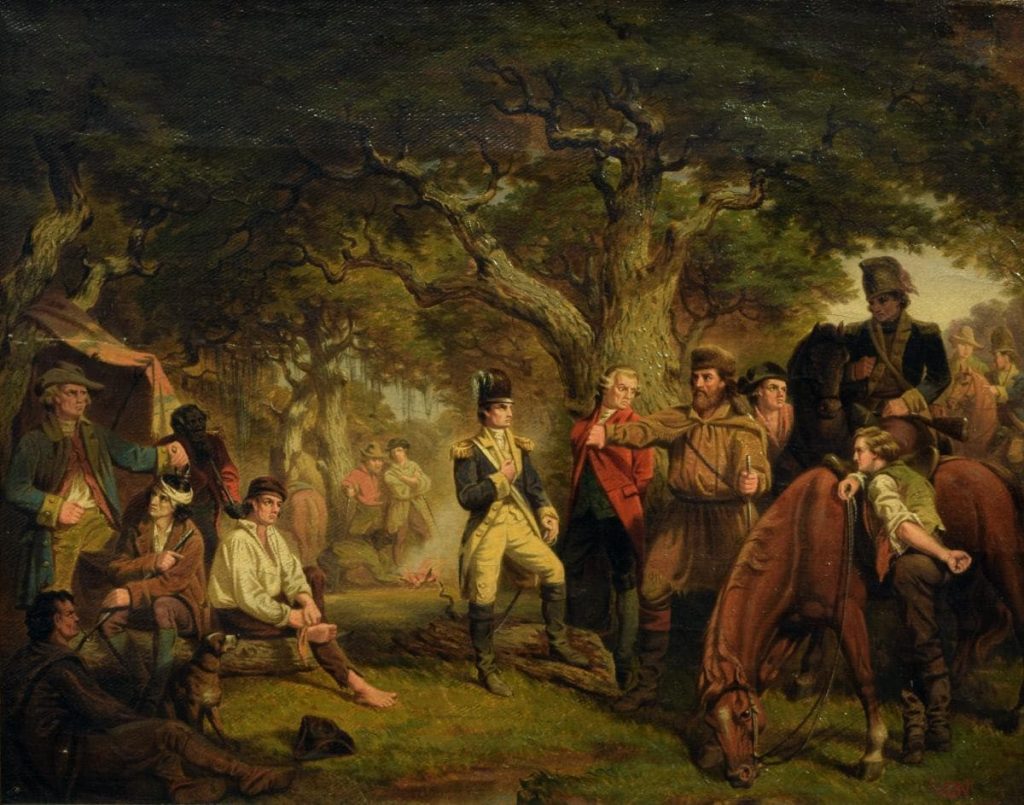
His men were no match for a large British force, but they were extremely agile, and could strike targets quickly before fading into the South Carolina forests and marshlands.
Soon after assembling his force, Marion struck a British transport of 150 American prisoners of war near Great Savannah. The operation was a success, freeing the POWs.
Beginning in September and October 1780, Marion consistently struck British and Loyalist forces, causing significant headaches for their high command. He succeeded in disrupting supply lines, capturing weapons, and breaking up opposition units.
He and his men knew the lands they were fighting in like the backs of their hands, and had significant experience maneuvering through swamps and other difficult terrain. They would use this advantage to stage surprise attacks, and quickly leave the scene before the British could organize a significant resistance.
By this time, Marion had become a big enough problem that Cornwallis ordered one of Britain’s most formidable cavalry commanders, Lieutenant Colonel Banastre Tarleton, to pursue him.
Tarleton commanded the fast-moving British Legion and was experienced in chasing American militia.
In November, Tarleton pursued Marion for more than twenty miles through the South Carolina countryside toward Ox Swamp, near modern-day Manning, SC. Marion withdrew rapidly along routes familiar to his own men, which were difficult for the British cavalry to follow.
Eventually, Tarleton abandoned the pursuit. He is said to have complained that even the Devil could not capture the “old fox”, leading to Marion receiving the nickname “Swamp Fox”. However, this nickname was only popularized after Marion’s death.
Later Revolutionary War
In the winter of 1780-81, Marion set up a base with his men at Snow’s Island, a naturally protected area surrounded by waterways and swamps near the Pee Dee and Lynches Rivers.
Here, he continued to threaten British supply lines and communication, conducting guerrilla attacks, and tying up British resources spent trying to track him down.
In late 1780, Major General Nathanael Greene was given command of the Continental Army in the Southern Colonies, and he knew how to use Marion’s men to their full effect.
Throughout 1781, Marion contributed to Patriot victories at Fort Watson in April and Fort Motte in May, before fighting at Quinby Bridge on July 17, Parker’s Ferry on August 13, and the Battle of Eutaw Springs on September 8 of that year.
The British were being pushed back toward their stronghold of Charleston, and fighting continued throughout 1782. Eventually, under the leadership of Greene and with Marion’s help, the British were forced to evacuate Charleston in December 1782.
Later life
After the war, Marion returned to Pond Bluff, only to find it in ruins.
His slaves had abandoned the plantation, many encouraged by British promises of freedom to those who defected to their side. The farm was also heavily damaged in the fighting.
Marion received an annual stipend in return for his efforts during the war, and also participated in South Carolina politics. He served in the South Carolina Senate from 1783 to 1786, returned in 1791, and served again from 1792 to 1794. He also participated in South Carolina’s 1790 constitutional convention.
On April 20, 1786, at approximately 54 years old, he married his cousin Mary Esther Videau, who was around 49 years old. They had no children.
Marion died on February 27, 1795, at Pond Bluff, and is buried in the family cemetery at Belle Isle Plantation, a property owned by his brother Gabriel, in what is now Berkeley County, South Carolina.
The original Pond Bluff plantation site was submerged following the twentieth-century construction of Lake Marion, which was itself named after the Swamp Fox.