Contents
About the author

Edward A. St. Germain created AmericanRevolution.org in 1996. He was an avid historian with a keen interest in the Revolutionary War and American culture and society in the 18th century. On this website, he created and collated a huge collection of articles, images, and other media pertaining to the American Revolution. Edward was also a Vietnam veteran, and his investigative skills led to a career as a private detective in later life.
Contents
Georgia was a pluralistic, diverse colony, inhabited by a wide range of different religious groups. However, Catholics were excluded from the colony from the very beginning.
Founding and early history
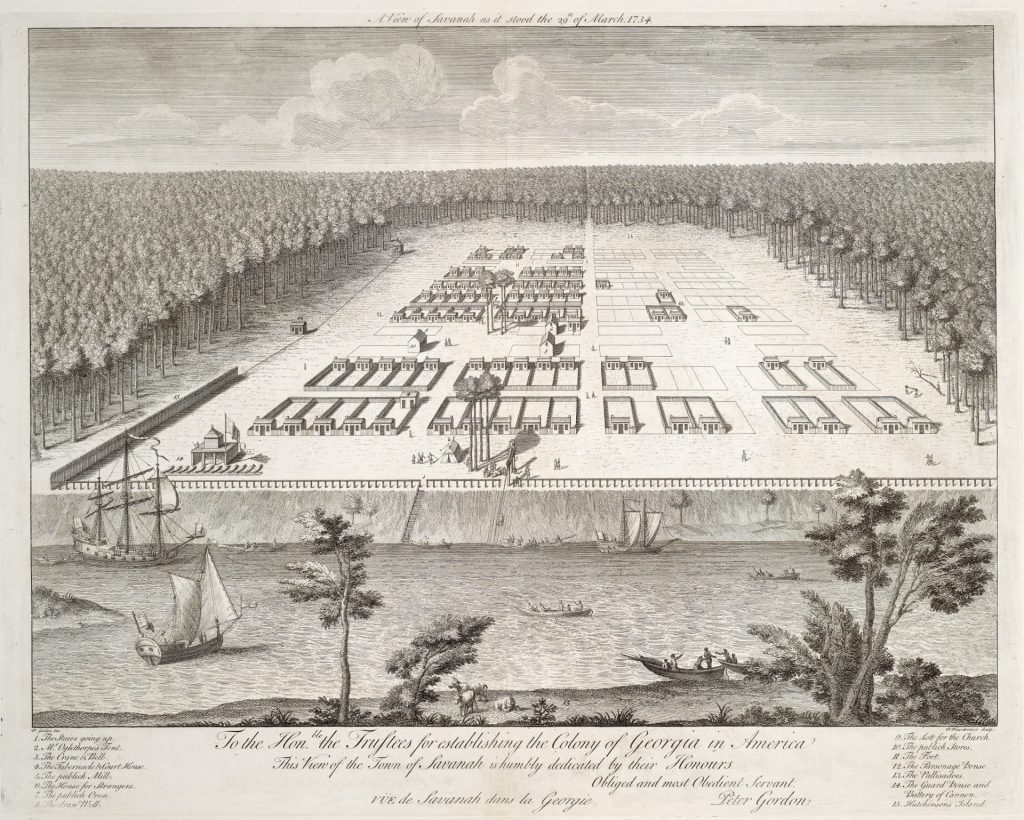
Georgia was founded in 1732 as a buffer state between Spanish Florida and the rest of the Thirteen Colonies.
Initially, the colony was placed under the control of a group of trustees based in England, and led by James Edward Oglethorpe.
To encourage initial settlement in the colony, the 1732 Charter of Georgia provided for religious freedom. However, Catholics were specifically excluded, as it was feared they would collaborate with the Spanish in the south to undermine the effectiveness of Georgia as a colonial buffer state.
…all such persons, except papists, shall have a free exercise of their religion…
– 1732 Georgia Charter
Quakers were explicitly allowed to affirm their truthfulness rather than swearing an oath on the Bible, allowing them to run for elected office and serve on juries. This was not always the case in some other more Anglican-dominated colonies, such as Virginia.
“…in like cases to administer the solemn affirmation to any of the persons commonly called quakers, in such manner as by the laws of our realm of Great-Britain, the same may be administered.”
It is commonly reported that Georgia excluded Jews, but this was not the case. They began migrating to the colony as early as 1733, and only Catholics were specifically prohibited from entering the colony by the Georgia Charter.
As a result of the freedom of religion granted in law, Georgia’s first settlers came from a wide variety of different sects. This included Anglicans, Scottish Highland Presbyterians, Moravians, and German-speaking Lutheran Salzburgers.
The first settlers of Georgia generally established their own towns with other members of their sect, and began to form local church congregations.
For example, Highland Presbyterians founded the town of Darien in present-day McIntosh County in 1736, while Salzburgers established the first Lutheran Church in Georgia at Ebenezer, in Effingham County.
Jewish populations were centered on Savannah, and formed their first congregation, called Mickve Israel, in 1735.
Georgia as a frontier state
Because it was designed to protect other colonies from Spanish Florida, Georgia became very militarized early on in its history.
This caused problems for some religious sects, such as Quakers, who opposed fighting and practiced pacifism. As a result, there were few Quakers in Georgia during its early history.
This was also one of the reasons why the Moravians, who were another pacifist sect, left Georgia in 1740 – just a few years after coming to the colony.
The Great Awakening
The 1730s and 1740s saw a period of intense religious revival across the Thirteen Colonies, and this shaped Georgia during its early history as well.
During this time, preachers traveled throughout British North America, promoting a more evangelical, individualistic format of Protestantism.
They challenged the existing religious institutions, and spread the idea that all men were equal in the eyes of God. Non-believers and Christians alike were encouraged to undergo a religious conversion to an evangelical faith, and live their life as a “born-again” Christian.
One of the most famous preachers of the Awakening, George Whitefield, had strong ties to Georgia, having set up Bethesda Orphanage in Savannah in 1740. He used the town as a base in the American South during his time as a traveling preacher.
The young Georgia Colony was receptive to this new style of Protestantism, especially given it did not have an official church or well-established Anglican or Puritan infrastructure at the time.
The Awakening led to the eventual growth of the Baptist and Methodist movements in Georgia later in the century, as people searched for a more modern, more evangelical style of sermon to attend, focused on the conversion experience.
George Whitefield’s influence in Georgia
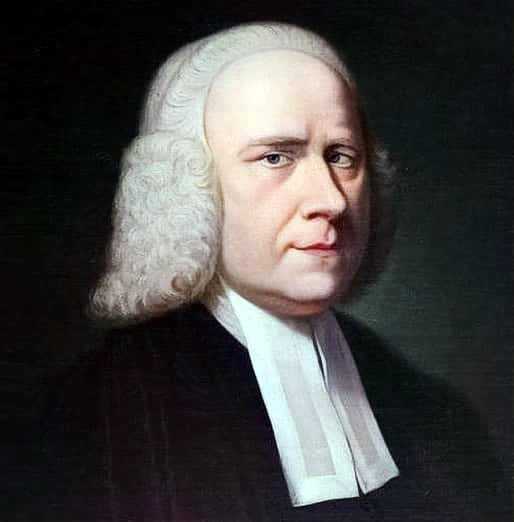
Whitefield was a celebrity in Georgia and in the wider South, and was welcomed by fans each time he arrived in the colony. As a result, people listened to what he had to say, including on political matters.
In the 1740s, Whitefield campaigned heavily to repeal Georgia’s ban on slavery, which had been in place since 1735. A slaveowner himself, he stated that slaves should not be treated harshly, and should be able to convert to Christianity, but used his influence in Georgia to lobby for the practice to be officially allowed again.
In 1751, Whitefield and the rest of the pro-slavery movement was successful, and the practice was once again permitted in Georgia Colony.
Slavery and religion
Slavery was practiced in Georgia from the very early days of the colony, even while it was officially outlawed. However, the number of slaves increased significantly after the practice was legalized again.
Most slaves in Georgia came from Central and West Africa, and brought with them their own spiritual beliefs. These were often centered around a reverence for one’s ancestors, performing rituals and dances, and casting spells to promote spiritual growth and healing.
At the same time, many slaves bought into Revival Christianity, as it promoted ideals of freedom and liberty.
As a result, Georgia’s slaves often practiced a combined form of Christianity and African religion, known as hoodoo, while others continued practicing their homeland’s beliefs, or converted to Christianity if allowed to by their masters.
The royal era (1752-1776)
In 1752, facing financial difficulties, the initial trustees of Georgia handed the colony over to the Crown, and the settlement came under royal control.
This led to the official establishment of the Church of England in the colony in 1758, in line with British government policy back home. Parish taxes were implemented, and local government was organized through the church in most parts of the colony.
However, apart from the implementation of parish taxes, the influence of the Anglican movement remained relatively limited under English control.
Non-Anglicans could still run for the parish vestries (the church’s elected bodies, responsible for local government), and other faiths were still allowed to organize their own congregations.
Anglican infrastructure was relatively weak, and other movements were able to continue practicing their faith unrestricted, including Quakers and Jews. In effect, there was still almost complete freedom of religion in the colony.
As a result, Georgia remained pluralistic throughout the entire colonial era, up until it achieved statehood in 1776. However, Catholics remained officially excluded from the colony throughout its entire history.