
Contents
About the author

Edward A. St. Germain created AmericanRevolution.org in 1996. He was an avid historian with a keen interest in the Revolutionary War and American culture and society in the 18th century. On this website, he created and collated a huge collection of articles, images, and other media pertaining to the American Revolution. Edward was also a Vietnam veteran, and his investigative skills led to a career as a private detective in later life.
Contents
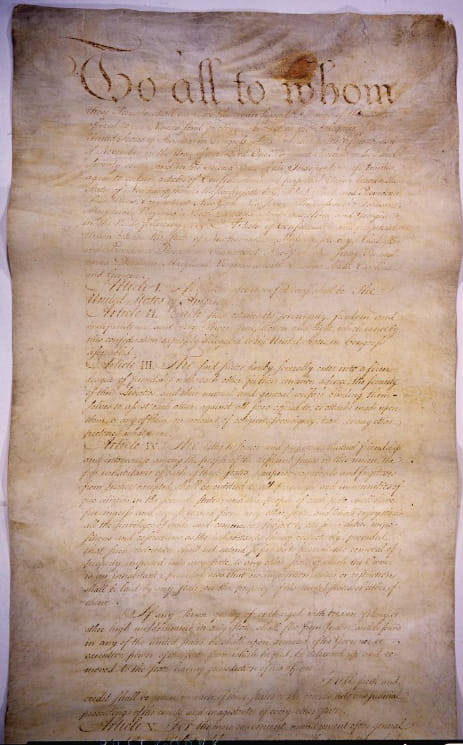
The Articles of Confederation were the first constitution of the United States of America, approved by the Second Continental Congress on November 15, 1777, during the Revolutionary War.
The Articles of Confederation were flawed in that they did not give the federal government the powers it needed to do its job effectively.
Weaknesses of the Articles of Confederation
1. The federal government struggled to implement taxes
The Articles of Confederation did not give the federal government the power to levy taxes on the population.
Instead, the states were responsible for taxation, and Congress was to request the money it needed to fund things such as the military.
In practice, states often exercised their right to refuse these requests, or did not pay the full amount demanded, leading to financial difficulties for the federal government.
2. The federal government could not effectively raise an army or control the nation’s military
Under the Articles of Confederation, the federal government was heavily reliant on state support in order to build and maintain the country’s military forces.
In effect, states were responsible for raising troops and maintaining militias, which led to disorganization, and made it harder to effectively coordinate resistance against the British Army.
This also led to issues postwar. After the Treaty of Paris was signed, the British continued to occupy certain western forts against the terms of the agreement, and Congress struggled to deal with this problem due to a lack of military control.
3. States’ voting rights were imbalanced, and it was difficult to pass new laws
In Congress, each state was given exactly one vote when it came time to pass legislation or other motions, regardless of its population. This meant that representatives of smaller states held outsized influence.
In addition, a supermajority of nine out of 13 states was required to pass most important congressional votes, making it impossible at times to implement important reforms.
4. Congress had limited ability to enforce laws
Even when resolutions were passed in Congress, there was a lack of a federal executive branch, making it difficult for the federal government to enforce the laws it was making.
The Congressional President did not have the powers of the current position of U.S. President, such as the ability to sign executive orders, nor was there an equivalent of the modern-day FBI or CIA.
The federal government’s lack of authority when it came to law and order was most notably illustrated during Shays’ Rebellion in 1786-87, in which a group of farmers rebelled and nearly overthrew the Massachusetts government in response to an unfolding economic crisis.
Shays’ Rebellion lasted for more than six months in large part because of the federal government’s inability to control the situation, as well as the fact that local militia units often sympathized with the rebel cause.
5. Congress could not regulate trade or the economy
This responsibility was predominantly left up to the states, which led to an effective free-for-all when it came to trade and economic policy.
States levied tariffs on each other and on other countries, often making it costly and complex to trade with the United States, and for states to trade with each other.
For foreign countries and companies, conducting commerce with America was similar to dealing with 13 separate nations, instead of a single country. And the competition between states, implementing taxes and tariffs on one another, hurt the American economy more broadly.
Many states ran into issues with debt, inflation, and currency inconsistencies, which the federal government could do little to resolve.
6. The court system was ineffective
The Articles of Confederation failed to create a federal court system, again leaving the responsibility of managing judicial systems up to the states.
This made it even more difficult for the federal government to enforce the law. It also made it at times impossible to settle disagreements between states, which became an increasing issue as interstate trade wars escalated.
7. The document was difficult to amend
Amendments to the Articles of Confederation required the agreement of all 13 states, not just a nine-out-of-13 supermajority. As a result, no amendments to the Articles were ever passed.
Why did the Articles have these issues?
The Articles of Confederation were drafted by a committee led by John Dickinson, a Patriot politician, from 1776 to 1777.
At the time, the primary fear of the drafting committee was of creating a central government that was too powerful, leading to overreach and excessive taxation, as the colonists had experienced in the 1760s and 1770s under British rule.
Therefore, the Articles were designed to avoid establishing a strong central power, and instead aimed to keep large amounts of authority in the hands of the states.
Each state retains its sovereignty, freedom, and independence…
– Articles of Confederation
However, in practice, the structure of the Articles of Confederation proved to give too little power to the federal government, leading to it becoming ineffective in governing the new United States.
Eventually, after discussions between state representatives at the Annapolis Convention in 1786 and later the Philadelphia Convention in 1787, the Articles of Confederation were replaced by the United States Constitution, which went into force on March 4, 1789.