
Contents
About the author

Edward A. St. Germain created AmericanRevolution.org in 1996. He was an avid historian with a keen interest in the Revolutionary War and American culture and society in the 18th century. On this website, he created and collated a huge collection of articles, images, and other media pertaining to the American Revolution. Edward was also a Vietnam veteran, and his investigative skills led to a career as a private detective in later life.
Contents
The Massachusetts Bay Colony’s economy was spread out across a number of different industries, with a large reliance on lumber, rum, and the seafood trade.
Rum
Massachusetts Bay had a large rum production industry, and exported the product throughout the colonies and abroad.
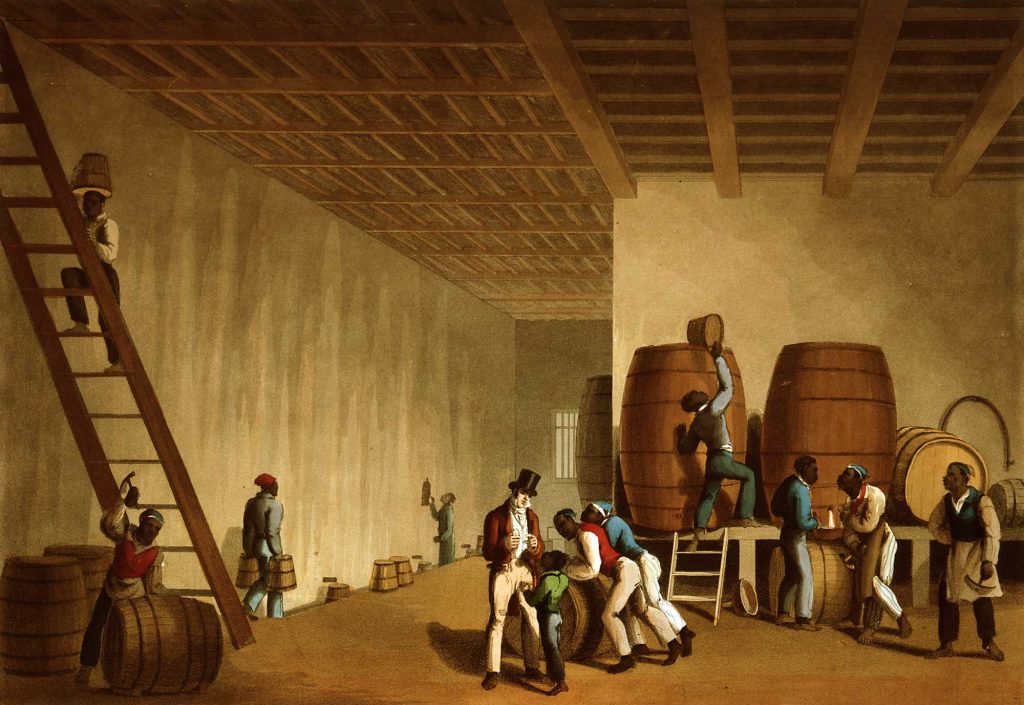
The industry started as early as the 1650s, with small distillation operations set up in people’s homes.
During the 1700s, the industry expanded significantly, with large distilleries created in major cities such as Boston. By the mid-1700s, Massachusetts was responsible for producing 40% of all rum distilled in North America.
The sugar and molasses necessary to make rum were imported from the West Indies, where they were produced using slave labor.
The majority of Massachusetts’ rum was consumed domestically, though some was exported to the West Indies and Europe.
Fishing
Seafood was one of the most important exports for the Massachusetts Bay Colony.
The fishing industry was primarily centered on cod, which was eaten locally in large quantities, and also preserved and exported to Europe and the West Indies.
Other seafood such as mackerel and oysters was also caught and sold by Massachusetts fishermen.
Lumber
Massachusetts did not quite have the same quantity and quality of pine trees that New Hampshire did, but lumber was still a key industry for the colony.
This was especially true after most of Maine, with its forests, came under Massachusetts’ jurisdiction from the 1650s, and during the period New Hampshire was part of Massachusetts Bay from 1641 to 1679.
Logging took place along rivers such as the Saco, Piscataqua, and Merrimack, as well as in the south of present-day Maine, before the logs were transported downstream for processing at Massachusetts sawmills.
Ship masts (or pine trees suitable for masts) were the single most important economic output of the colony’s lumber industry. These masts were installed on ships across the Thirteen Colonies, and also exported to England.
Massachusetts timber was also used to produce barrels, houses, and other parts of merchant and Royal Navy ships.
Shipbuilding and maritime trade
As Massachusetts developed, a thriving shipbuilding industry was established in the colony.
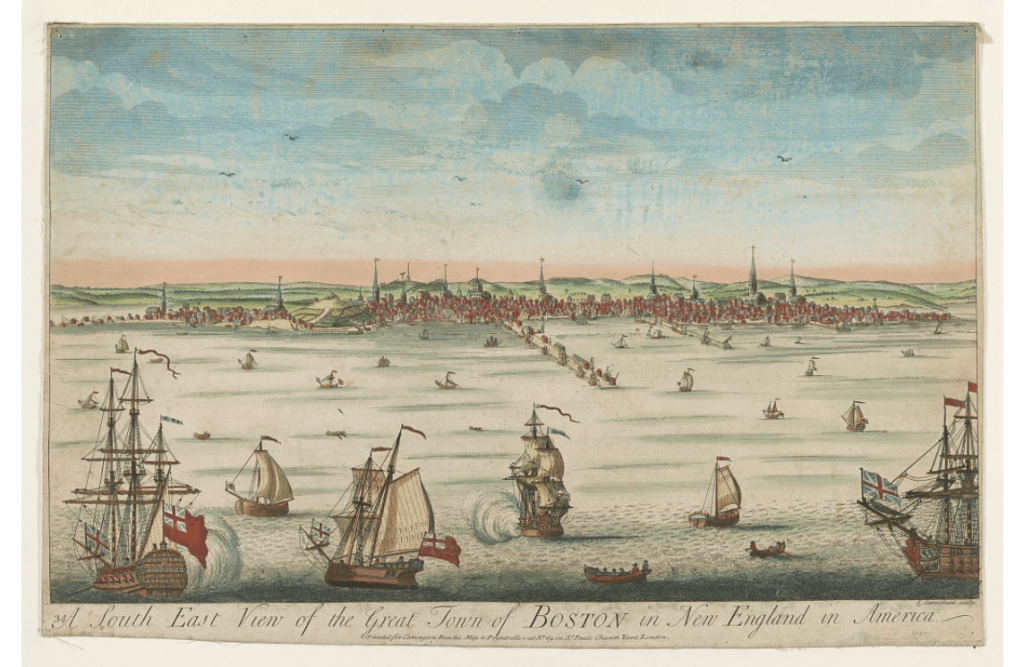
Primarily located in Boston and Salem, craftsmen would take local timber, as well as wood from elsewhere in New England, and use it to make fishing boats and merchant ships, and ship hulls were also exported as a separate product.
The shipbuilding industry also supported a range of related businesses such as ropewalks (for spinning, cutting, and finishing ships’ rigging), sail-makers, and carpenters.
The vast majority of Massachusetts’ international trade passed through Boston, with significant activity at other ports such as Salem, giving rise to a number of ancillary industries such as warehousing, packing and packaging, and even maritime insurance brokering.
Agriculture
Like the other New England colonies, Massachusetts Bay did not produce significant surpluses of agricultural products.
The soil was rocky, making it difficult to farm, and the climate in the colony made for short growing seasons.
In the 1630s, families set up subsistence farming to support themselves, which later grew into larger farms as the colony developed. However, Massachusetts did not have the types of large manor farms or plantations seen in New York and Georgia for example.
Wheat, corn, and rye were among the most popular crops grown in the region, but could not be produced in the same quantities as in the Middle Colonies.
As a result, Massachusetts farmers focused heavily on raising livestock to support themselves, especially cattle.
Cows were brought into Massachusetts as early as the 1620s, and the colony was renowned for its beef and leather production.
Similar to cod, beef was also preserved in Massachusetts and exported internationally.
Slavery
In 1770, the black population of Massachusetts was estimated at 4,754 – approximately 2% of the total citizenry – the majority of which were slaves.
Rather than working on farms or plantations, as was common in other colonies, slaves in Massachusetts predominantly worked as household servants.
Many also worked in the maritime industry, such as on the docks at Salem and Boston.
To learn more, read our article on the broader economy of colonial New England.