Contents
About the author

Edward A. St. Germain created AmericanRevolution.org in 1996. He was an avid historian with a keen interest in the Revolutionary War and American culture and society in the 18th century. On this website, he created and collated a huge collection of articles, images, and other media pertaining to the American Revolution. Edward was also a Vietnam veteran, and his investigative skills led to a career as a private detective in later life.
Contents
If we were to hear them speak today, most of the Founding Fathers of the United States would be considered to have an American accent, but it would have sounded different from the American accents of the modern era.
The origins of the American accent
While first-generation migrants predominantly retained their British, German, French, or other accents from their home country, the first American-born settlers in the Thirteen Colonies had an accent that was different from any heard in Europe before.
Beginning around the mid-1600s, the first American accents started developing, which evolved into the dialects we hear around the nation today.
Colonial accents developed differently by settlement throughout the 1700s, and there was also a rural and metropolitan divide as well.
In 1739, Benjamin Franklin wrote about these different accents in different parts of the Thirteen Colonies:
“…when a Pennsylvanian would say panther, he shall say painter. When a New-Yorker thinks to say this he shall say diss and the People in New-England and Cape May will not be able to say cow for their Lives, but will be forc’d to say keow by a certain involuntary Twist in the Root of their Tongues…”
However, though colonial accents were recognizably different from British English, the difference was not as distinct as it is today. It was generally more of a midway point between older English accents and the modern American accent.
It is important to note that at the time, the British accent sounded slightly different to how it does today, though we would still recognize it as British.
For example, depending on the region, modern British English may pronounce “face” as “fayce,” but this would have sounded closer to “fehce” in the 1700s. Similarly, “home” may have been said as “hohm” instead of the modern “ho-um.”
When a man from Derbyshire, England, traveled through the colonies from 1774-1777, he noted that the colonists spoke good English that was easy to understand. He stated that regional dialects were generally not that noticeable, except when he visited New England.
“Though the inhabitants of this Country are composed of different Nations and different languages, yet it is very remarkable that they in general speak better English than the English do. No County or Colonial dialect is to be distinguished here, except it be the New Englanders, who have a sort of whining cadence that I cannot describe.”
Though the New England accent was noticeable by the 1770s, the modern-day Southern American accent had not yet developed by the end of the Revolutionary War.
The accents of the Founding Fathers
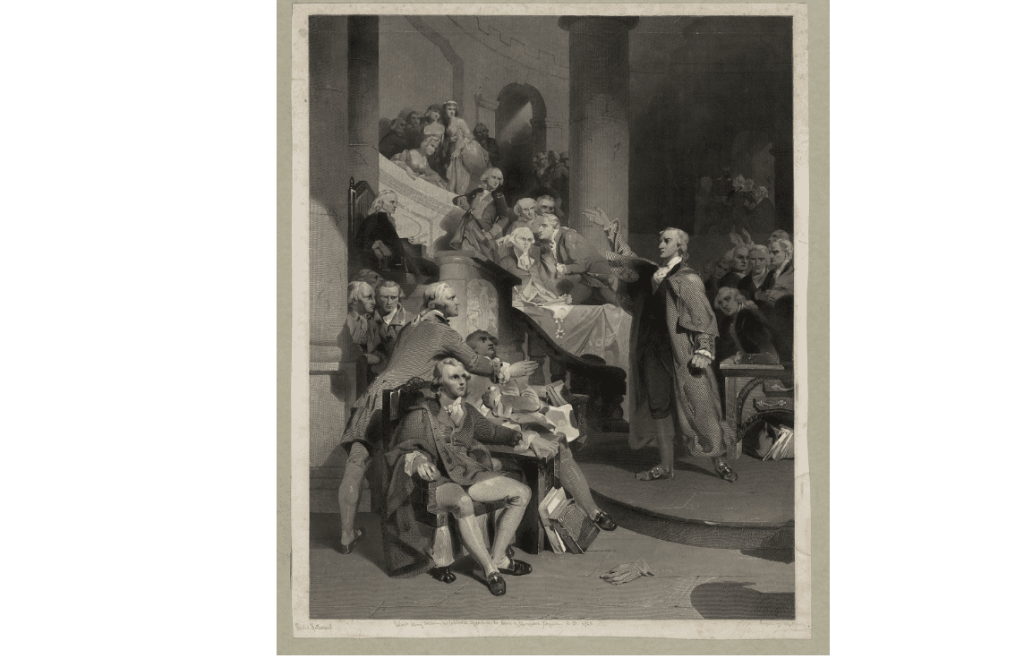
Most of the most famous Founding Fathers were born in the Thirteen Colonies, and as a result, they had various different types of colonial American accents depending on their background and education, family, and exact place of birth.
In general, they did not have posh, aristocratic British accents – whereby “car” for example is pronounced with a very soft “r,” such as “cah” – though this dropping of the “r” sound was characteristic of New England accents in the colonial era.
Today, the Founding Fathers’ accents would sound like a mixture between old British English and American English.
- George Washington would have had an upper-class American accent with hints of British influence. Though he grew up in rural Virginia, he did not have a Southern drawl, meaning he would not have pronounced “bed” as “bay-ud” for example, but would have sounded American if we were to hear him speak today, with noticeable traces of the British accent coming through.
- Thomas Jefferson would have sounded similar to Washington, but potentially slightly more posh, due to his upbringing in the Virginian gentry.
- Benjamin Franklin would have sounded more American and less British, with the stronger Boston/New England accent of the time.
- John Adams would have sounded similar to Benjamin Franklin, also hailing from New England, specifically Massachusetts.
- Alexander Hamilton would have had a unique accent, having been born and raised in the Caribbean until the age of 17. He likely retained at least some British West Indian colonial influence in his accent, subsequently mixed with educated New York speech.
- James Madison would have had a similar Virginian gentry accent to Washington and Jefferson.
- Samuel Adams would have shared a similar stronger New England accent to that of Franklin.
- John Hancock would have also had a New England accent, though his wealth and education probably gave him a more polished upper-class way of speaking.
- Patrick Henry would have sounded similar to Washington and Jefferson due to his links to Virginia.
- John Jay would have had a colonial New York upper-class accent. His family was Huguenot, but he grew up speaking English in New York, so he most likely spoke with an educated New York colonial accent rather than a French accent. His accent would not have been as strong or as distinct as the New York accent of today.