Another Prophecy | American Revolution War Song

The following lines appeared in the early part of 1777, with this introduction. “As the superstition and weakness of human nature is such, that sometimes the most trivial circumstance; or…

Everything you've ever wanted to know about the American Revolution
Read books written about the American Revolution.
The following lines appeared in the early part of 1777, with this introduction. “As the superstition and weakness of human nature is such, that sometimes the most trivial circumstance; or…
This parody on the “Watery God” was occasioned by the success of the Americans at Trenton and Princeton. It was published a short time after those victories, and soon became…
This song was probably written in England. There were several versions of it published in this country. We select the best. The Heads YE wrong heads, and strong heads attend…
Numerous songs, odes, epigrams and pasquinades, commemorating this battle, appeared during the war. We have several loyal productions upon this subject; but they are too profane and corrupt for publication…
To the Tune of Smile Britannia: RISE, rise, bright genius rise, Conduct thy sons to war; Thy spear pois’d to the skies, Whirl, whirl, thy rapid car; Fire each firm…
The defiance and devotion expressed in these verses, are an excellent illustration of the spirit of the times, in which they were written. The author, Dr. Jonathan Mitchell Sewall,1 of…
This song was written in England, and first published in the Middlesex Journal, over the signature of M. On a broadside, dated 1777, the author says: “My efforts were so…
This bold song appeared in the “Freeman’s Journal,”1 about one mouth previous to the declaration of independence, as a “Parody on an ode published in the Town and Country Magazine,”…
This ironical, and burlesque old song, was composed in the early part of 1777. The author treats of the unsuccessful attack on Sullivan’s Island, by the British, in the summer…
The particulars known, concerning the capture, trial, and execution of this gallant, and much lamented young officer, are few. Washington, after the retreat of his army from Long Island, in…
This song must have been very popular with the loyalists, as four different editions were published in broadsides, during the two years following its first appearance, in the “Halifax Journal,”…
The origin of this specimen of the “Yankee Psalms and Prayers ” is unknown. There are numerous versions of it, but this is the only one that is above mediocrity,…
These congratulatory verses were sung by the soldiers of the Continental Army, after the evacuation of Boston. It appeared under various names, but was generally known by its present title,…
This song appeared in the Connecticut Gazette, while the British troops held possession of Boston. It was afterwards published in ballad-sheet, and recently reproduced in Buckingham’s Memoirs, sentiment being a…
It is supposed this song was first published in 1776. We have a music sheet containing it, and the “Liberty Song,” bearing the following impress: “Portsmouth; printed by Benjamin Dearborn,1…
Though this song has but slight pretensions to literary merit, its subject long made it popular among the colonists. It was first printed in the Pennsylvania Magazine, and occasionally reprinted…
Very many songs, bearing this title, were produced during the revolution. This spirited one was originally published as a broadside, early in 1776. At a later period, it appeared in…
A New Song to an Old Tune WHAT a court, hath old England, of folly and sin, Spite of Chatham and Camden, Barre, Burke, Wilkes and Glynn ! Not content…
J. W. Hewlings, the author of this ballad “on the present critical times,” was a native of Nansemond, Virginia, where he died, in the early part of the year 1793.…
Notwithstanding the prominent position in which General Washington was placed at the head of an undisciplined army, and the effect which that position produced upon the minds of the well…
During the battle, upon this hill, the village of Charlestown was destroyed. The subjoined lyric, commemorating the event, has been attributed to Joel Barlow. He composed various patriotic songs, many…
This happy production of “Paddy,” must have been very popular with “the rebels,” as there were four different editions of it published as broadsides, a short time after its first…
The author of this ballad is unknown. It appeared originally if the “Poet’s Corner” of Dunlap’s Packet, as the “Pennsylvania March,” to the tune of the Scots’ song, “I winna…
This production appeared in a ballad sheet in the early part of 1775, and was afterwards reprinted in the Constitutional Gazette, with a slight abridgment in the text. Alphabet Song…
The authorship of this chaste ballad has been assigned to one Jere. Sargent, of Philadelphia, a person of whom little is known; and also to Francis Hopkinson, the author of…
This excellent parody is attributed to Oliver Arnold,1 a native of Norwich, Connecticut, and a kinsman of the traitor. He wrote much doggerel during his time, some of which is…
This beautiful song was very popular, both in England and the colonies. It was composed by John Tait, a writer to the Signet and, for some time, a judge in…
About the middle of December, 1774, deputies appointed by the freemen of the province of Maryland, met at Annapolis, unanimously resolved to resist the authority of Parliament, taxing the colonies,…
In January, 1775, William Franklin, the governor of the colony of New Jersey, addressed the legislature, warning them not to sanction certain proceedings connected with the dispute existing between the…
Thomas Hutchinson was recalled to England early in 1774, and General Gage appointed as his successor in the office of governor of Massachusetts Bay. On his arrival at Boston, in…
This ballad first appeared in Fowler’s Gazette, on the twenty-second of July, 1774, but soon after was adapted to a sacred air, and published in a broadside. It has been…
Many urgent appeals to the people of the different colonies were made after the destruction of the tea at Boston, calling upon them to abstain from the use of all…
On the tenth day of May, 1773, the East India Company were authorized, by act of Parliament, to export their tea, free of duty, to England, but with a tax…
These verses appeared in a broadside, a short time after the “massacre of the fifth of March,” 1 1770, as a “new song much in vogue among the friends to…
In the year 1768, the people of Boston resolved that they would not import any tea, glass, paper, or other commodities commonly brought from Great Britain, until the act imposing…
This loyal song is much the best of those composed during the earliest struggles of the Colonists, and is forcibly illustrative of the nature and spirit of the times in…
This parody, upon the preceding song (The World Turned Upside Down), was first published in the Boston Gazette, on the twenty-sixth of September, 1768, with the subjoined brief notice. “Last…
The ballad entitled “The World Turned Upside Down, or, The Old Woman Taught Wisdom,” was published, originally, in the Gentleman’s Magazine, and afterwards on a music-sheet, set to the tune,…
THE incident which gave rise to the following satirical parody of Popes second pastoral, occurred during the debates in Parliament early in the year 1766, which took place on occasion…
The Stamp Act was passed on the tenth of January, 1765, and repealed on the twenty-second of February, of the next year. The news of its repeal was hailed with…
This beautiful ballad was written by Thomas Paine, the author of “The Age of Reason,” and published in the Pennsylvania Magazine of July, 1775, while he was editor of that…
Peter St. John, the author of the following excellent ballad, was a native of Norwalk, Connecticut. During the early struggles of the Revolution, he kept a school in his native…
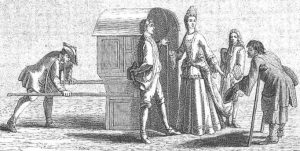
“ Editor’s note The following is an excerpt from a book “THE EIGHTEENTH CENTURY Its Institutions, Customs, and Costumes. FRANCE, 1700-1789.” by PAUL LACROIX (1876). It illustrates what French fashion…